Posted On May 15, 2026
How to Turn Your AI Idea Into a Working MVP Quickly
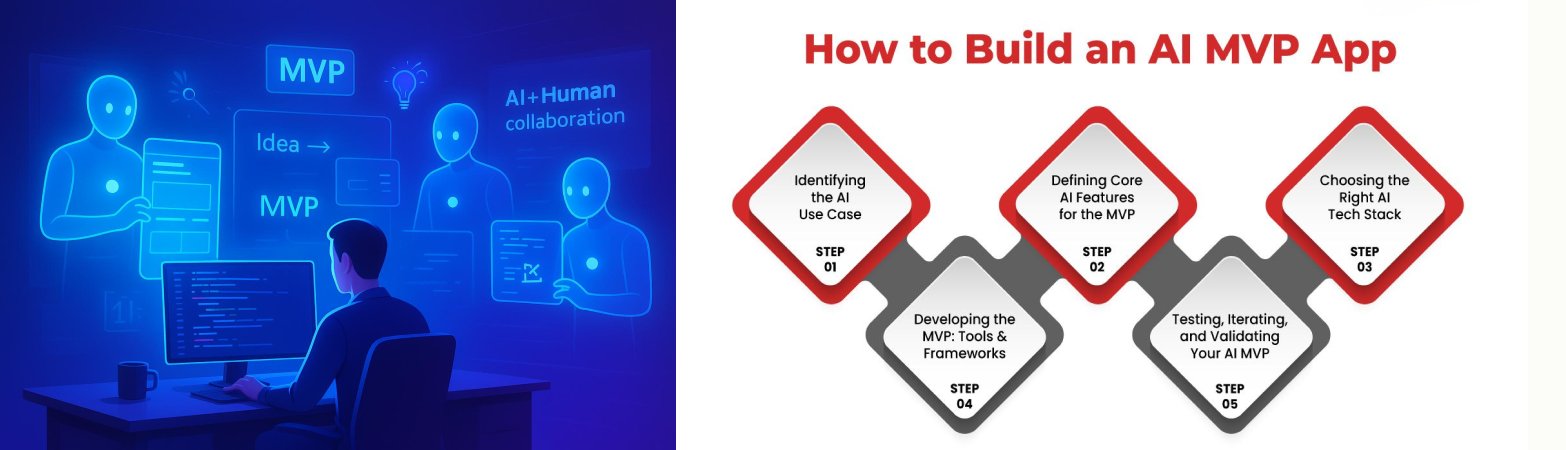
Many businesses and startups have promising AI ideas, but turning those ideas into real products can feel challenging. One of the biggest mistakes companies make is spending too much time building complex systems before validating whether the product solves a real problem. This is why AI MVPs, or Minimum Viable Products, have become an important part of modern product development.
An AI MVP helps businesses launch faster by focusing only on essential features needed to test the product idea with real users. Instead of aiming for a perfect product immediately, companies can validate demand, collect feedback, and improve the solution step by step. Lean MVP development strategies are widely used because they reduce development risks and help businesses make smarter product decisions.
Start with a Clear Problem Your AI MVP Will Solve
The first step in building a successful AI MVP is identifying a clear and specific problem. Many startups focus heavily on AI technology itself instead of understanding what users actually need.
A strong AI MVP should solve one important problem in a simple and effective way. For example, an AI chatbot could help automate customer support queries, while an AI recommendation engine could improve product suggestions for online shoppers.
Businesses that clearly define the user problem early are more likely to build focused products with stronger market demand. Product development experts often recommend narrowing the MVP scope to avoid unnecessary complexity during the early stages.
Why Defining Core Features Helps You Launch Faster
One of the most common reasons AI projects become delayed is feature overload. Businesses often try to include too many functionalities before the product is even tested in the market.
Defining only the core features required for the MVP helps teams launch faster and reduce development costs. Instead of building a full-scale platform, startups should focus on the minimum functionality needed to solve the primary user problem.
This lean development approach allows businesses to gather real-world feedback earlier while improving the product gradually through future updates. MVP development frameworks consistently highlight that simplicity is one of the main drivers of faster product validation.
Choosing the Right AI Technology for Your MVP
Selecting the right AI technology is another important step in building an MVP quickly. Many businesses assume they need custom-built AI systems from the start, but this is not always necessary.
Pre-trained AI models, APIs, and cloud-based AI services can help accelerate development significantly. Businesses can use existing AI tools for tasks such as natural language processing, image recognition, recommendation systems, and predictive analytics without building complex infrastructure from scratch.
This approach reduces both development time and technical complexity while allowing startups to focus on testing the product idea itself. AI MVP development discussions regularly encourage businesses to use available AI resources during early-stage validation.
How to Validate Your AI Idea Before Full Development
Validation is one of the most important stages of AI MVP development. Before investing heavily in advanced features, businesses should confirm whether users are genuinely interested in the solution.
Simple methods such as landing pages, surveys, prototype demos, waitlists, and early-access testing can help measure customer interest before full-scale development begins. Real user feedback often provides more valuable insights than assumptions or internal opinions.
Lean startup methodologies and product validation experts consistently recommend launching quickly and testing ideas in smaller stages. This allows businesses to identify market demand early while reducing unnecessary financial risk.
Building a Lean AI MVP Without Unnecessary Complexity
A lean AI MVP focuses on speed, flexibility, and learning rather than perfection. Businesses should avoid overengineering systems with advanced features that users may not even need during the early stages.
The goal of an MVP is to create a working product that demonstrates the core value of the idea while remaining simple enough for rapid testing and iteration. Teams can improve scalability, automation, and AI sophistication later after gathering enough user insights.
Startup founders and AI product experts often highlight that launching early with a focused solution helps businesses learn faster and adapt more effectively to changing market needs.
Using Pre-Trained AI Models to Speed Up Development
One of the fastest ways to build an AI MVP is by using pre-trained AI models and existing AI services instead of creating everything from scratch. Modern AI platforms provide APIs and ready-to-use models for tasks such as chatbots, image recognition, recommendation systems, speech processing, and predictive analytics.
Using these existing technologies allows businesses to reduce development time and focus more on solving customer problems. Many startups now rely on third-party AI tools during early product development because they provide faster implementation and lower infrastructure costs.
AI development communities and MVP experts often recommend starting with existing AI solutions and improving them later as the product grows and user needs become clearer.
Creating a Simple User Experience for Faster Product Testing
A successful AI MVP does not need a highly advanced design. The goal is to create a product that users can understand and test easily. Many businesses make the mistake of spending too much time on visual design instead of validating whether the AI solution actually delivers value.
Simple onboarding, clean navigation, and clear workflows help users interact with the product more effectively. Research into MVP development strategies suggests that usability and functionality are often more important than complex design during early-stage product testing.
A basic but functional interface allows businesses to launch faster while collecting meaningful feedback from real users.
How Agile Development Helps AI MVPs Launch Quickly
Agile development methods play an important role in AI MVP creation because they allow teams to work in smaller and faster development cycles. Instead of spending months building a complete product, businesses can release updates gradually based on user feedback and testing results.
Agile workflows also help teams identify technical issues early and improve AI functionality step by step. Many AI startups use iterative development because it allows them to adapt quickly to changing market demands and customer expectations.
Studies on MVP engineering practices show that continuous iteration and experimentation are important for reducing development risk and accelerating innovation.
Testing Your AI MVP with Real Users Early
Launching early and testing with real users is one of the most important parts of AI MVP development. Many businesses wait too long before releasing products because they want every feature to be perfect. However, delaying user feedback often creates larger problems later.
Real users help businesses understand whether the AI product solves a genuine problem, whether the workflows make sense, and which features require improvement. Startups that collect early feedback are often able to improve products faster while reducing the risk of building unnecessary functionality.
Founder communities and startup experts frequently highlight that user validation is more valuable than internal assumptions during early-stage development. (reddit.com)
Improving Your AI Product Through Continuous Feedback and Iteration
An AI MVP should be treated as a learning tool rather than a finished product. Continuous improvement based on user feedback is what helps businesses transform early prototypes into scalable products.
After launch, teams should analyse user behaviour, monitor engagement, identify common issues, and prioritise the features users value most. This feedback-driven process allows businesses to make smarter development decisions while improving product-market fit over time.
Research on lean startup methodologies also supports the importance of iterative learning and continuous adaptation in technology product development.
Conclusion
Turning an AI idea into a working MVP quickly requires a clear focus on solving real problems, defining essential features, selecting practical AI technologies, and validating ideas early with users. Businesses that follow lean MVP strategies are often able to reduce development risks, launch products faster, and improve solutions through continuous feedback.
Instead of spending excessive time building perfect systems, startups and enterprises can benefit from releasing focused AI MVPs that support faster learning and smarter product decisions. Companies such as smartData help businesses accelerate AI MVP development through scalable product engineering and rapid validation strategies designed for modern AI-powered solutions.
Share on: