Posted On May 19, 2026
Cost Factors in AI MVP Development Explained Simply
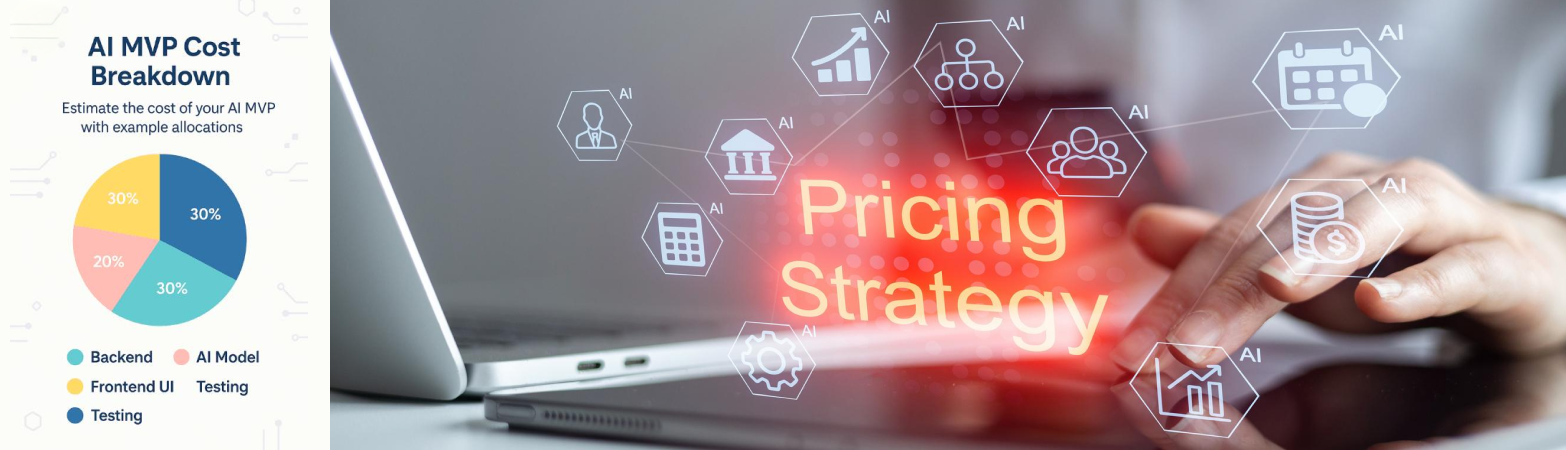
Building an AI MVP is one of the most effective ways for startups and businesses to test product ideas before committing to full-scale development. However, AI MVP development costs can vary depending on several technical and business factors. Many companies underestimate expenses because they focus only on coding while overlooking areas such as data preparation, infrastructure, integrations, and testing.
Understanding the major cost factors early helps businesses plan budgets more effectively and avoid unexpected development expenses. A well-planned AI MVP focuses on solving a core problem without adding unnecessary complexity, allowing businesses to validate ideas faster while managing costs more efficiently.
How Project Complexity Affects AI MVP Development Costs
One of the biggest factors influencing AI MVP costs is the overall complexity of the project. A simple AI chatbot or recommendation engine generally costs less to build than advanced systems involving predictive analytics, computer vision, or large-scale automation.
The number of features, user workflows, third-party integrations, and AI capabilities directly impacts development time and technical requirements. Businesses that try to include too many features in the MVP stage often increase costs unnecessarily. Product development experts commonly recommend focusing only on essential features during early development to reduce risk and accelerate validation.
A smaller and focused MVP also allows businesses to gather user feedback more quickly before investing further.
The Impact of AI Features and Integrations on Your Budget
AI functionality itself can significantly influence development costs. Features such as natural language processing, image recognition, predictive recommendations, and voice assistants may require different levels of technical expertise and infrastructure.
In addition, many AI MVPs need integrations with payment systems, CRM software, cloud platforms, analytics tools, or external APIs. Each additional integration increases development complexity and testing requirements. Businesses should carefully evaluate which integrations are truly necessary during the MVP phase to avoid overspending.
Using existing AI APIs and third-party services can often reduce costs compared to building custom AI systems from scratch. Many startups now use pre-built AI services during early validation stages to launch products faster and more efficiently.
Why Data Collection and Preparation Increase AI MVP Costs
Data is one of the most important parts of any AI-powered product. AI models rely heavily on clean, structured, and relevant data to produce accurate results. However, collecting and preparing high-quality data can become a major cost factor during development.
Businesses may need to gather datasets, clean inaccurate information, organise data formats, and label training data before the AI system becomes usable. Research in AI development consistently highlights that poor-quality data can reduce AI performance regardless of how advanced the model itself may be.
For some AI MVPs, businesses can reduce costs by starting with smaller datasets or using publicly available data sources during early testing stages.
Choosing Between Pre-Trained Models and Custom AI Development
Another major pricing factor is whether the business uses pre-trained AI models or builds custom AI solutions from the beginning. Pre-trained models are generally faster and more affordable because they already include trained capabilities for common tasks such as text generation, speech recognition, or image analysis.
Custom AI development usually requires larger budgets because teams need to build, train, optimise, and test models specifically for the product. While custom models may provide better long-term flexibility, they are often unnecessary during the MVP stage.
Many AI MVP development strategies recommend starting with existing AI services and transitioning to custom development only after market validation. This approach reduces early development costs while allowing businesses to focus on user feedback and product growth.
How Team Structure Influences Overall Development Expenses
The size and experience of the development team also play an important role in AI MVP pricing. AI projects may involve software developers, AI engineers, UI/UX designers, data scientists, product managers, and quality assurance specialists.
Larger teams can accelerate development but also increase overall expenses. Businesses often choose between hiring in-house teams, working with freelancers, or partnering with AI development companies depending on budget and project complexity.
Experienced AI teams may cost more initially but can reduce long-term development risks through better planning, faster problem-solving, and scalable architecture design. Startup founders and product experts regularly highlight that efficient team management is essential for controlling AI MVP budgets effectively.
Infrastructure and Cloud Costs in AI MVP Development
Infrastructure is one of the major cost factors in AI MVP development. AI-powered products often require cloud servers, databases, APIs, storage systems, and computing resources to handle data processing and machine learning operations.
The overall infrastructure cost depends on how complex the AI system is and how much data the platform processes. Businesses developing AI chatbots, recommendation systems, or predictive analytics tools may need scalable cloud environments to support performance and reliability.
Many startups now use cloud providers and AI-as-a-service platforms because they reduce the need for expensive in-house infrastructure. This approach helps businesses launch faster while keeping early-stage operational costs under control.
The Role of UI/UX Design in AI MVP Budget Planning
While businesses often focus heavily on AI functionality, user experience design also plays an important role in MVP success. A technically advanced AI system may still fail if users find the platform confusing or difficult to use.
UI and UX design costs include wireframing, interface design, user testing, and workflow optimisation. Businesses that invest in simple and intuitive user experiences often improve engagement and customer retention more effectively.
Many MVP development experts recommend keeping the design clean and functional during the early stages instead of investing heavily in advanced visual features. The goal of an AI MVP is to validate the core idea while maintaining a smooth user experience. (saritasa.com)
Ongoing Maintenance and Post-Launch AI Costs Explained
AI MVP costs do not end after the initial product launch. Ongoing maintenance is an important part of AI product development because systems often require updates, bug fixes, model improvements, and infrastructure optimisation over time.
AI models may also need retraining as user behaviour changes or as businesses collect more data. In addition, companies must monitor performance, security, scalability, and API usage regularly.
Research and industry reports on AI product development suggest that businesses should always include post-launch support and maintenance in their overall budget planning. Ignoring these long-term costs can create operational challenges later. (revelo.com)
How Development Timelines Affect AI MVP Pricing
The development timeline has a direct impact on the total cost of an AI MVP. Projects with shorter deadlines often require larger teams, faster delivery cycles, and additional technical resources, which can increase expenses significantly.
On the other hand, overly long development timelines may also create budget problems because of ongoing salaries, infrastructure costs, and project management requirements. Businesses should focus on launching quickly with essential features rather than spending excessive time building unnecessary functionality.
Lean MVP development methodologies commonly recommend releasing smaller versions early and improving products gradually through continuous user feedback and iteration. This helps businesses control costs while accelerating validation.
Smart Ways to Reduce AI MVP Costs Without Compromising Quality
Businesses can reduce AI MVP costs by focusing on simplicity, prioritising core features, and using existing AI technologies instead of building everything from scratch.
Pre-trained AI models, open-source frameworks, low-code platforms, and third-party APIs can significantly reduce development complexity and speed up product launches. Many startups also reduce costs by launching with limited features and improving products gradually based on user feedback.
Product development experts frequently recommend validating market demand before investing in advanced AI capabilities. A smaller and focused MVP helps businesses avoid unnecessary spending while still collecting valuable customer insights.
Conclusion
AI MVP development costs depend on several factors, including project complexity, AI features, data preparation, infrastructure, and team structure. Businesses that clearly define goals, focus on essential features, and use lean development strategies are more likely to manage costs effectively while validating ideas faster.
Starting with a smaller and scalable MVP also allows companies to reduce financial risk and improve product decisions through real user feedback. Organisations such as smartData support startups and enterprises with AI MVP development services designed to help businesses build scalable solutions while maintaining cost efficiency and faster product validation.
Share on: